Overview
AchieveIt - exploratory independent project that aims to help students who struggle with procrastination
Timeline:
March 2023 - June 2023
Team:
UX Researcher, UX Designer
Role:
UX Researcher
Summary
Ever since students resorted to remote learning due to the pandemic, they are increasingly faced with distractions from digital technology every day. Different distractions have made procrastination easier and easier.
As a college student myself, I also constantly struggle with procrastination (whether it be watching a tv show or mindlessly scrolling through tiktok and instagram) and I notice the same patterns among my peers. Procrastination plagues our daily lives and our mental well-being. How can we help college students overcome this?
Problem
College students constantly struggle with procrastination
While it is obvious that putting our phones away will stop distractions and thus prevent procrastination, we still end up doing something else rather than finishing our work. Why is there this gap between our goals and our actual actions? Why do we still procrastinate when we know the solution?
Secondary Research / Literature Review
Procrastination can be traced to underlying complex psychological reasons; it is often a self-protection strategy for coping with conflicting motivations
For the project's first step, I decided to do some desk research on "procrastination" to understand the problem space boardly. According to Nic Voge at Princeton's McGraw Center for Teaching & Learning, procrastination can be understood with "Self-Worth Theory". It states that people believe their performance = ability = self-worth (e.g. grade on a test = their academic ability = their worth as a person), which is an unhealthy mindset.
He also characterizes procrastination as a a feeling of stuckness, two countervailing forces: we are driven towards success on the one hand, but we are strongly and powerfully motivated to avoid failure on the other
Now that I know procrastination is a complex problem that cannot be solved with just merely time management and shutting off distractions. I wanted to see what can truly and effectively help.
On top of mindfulness practices such as being forgiveful to yourself, choosing an appropriate place to do work, and managing your stress and emotions, two methods that directly impacts one’s work rate stood out to me:
1. Swiss Cheese It:
breaking down big tasks into small actionable ones, For example, if your task is to “read one chapter of the textbook,” start with “read one page of the textbook”.
2. Social support:
More social support = Less procrastination. I found a paper published in 2019 called “Internal Locus of Control, Social Support and Academic Procrastination among Students in Completing the Thesis” and stumbled upon this interesting finding:
There is a very significant negative correlation between social support and academic procrastination in completing a thesis. This result means that the lower level of social support, the higher level of academic procrastination in completing a thesis, and vice versa.
Some methods that may help...
Competitive Analysis
Apps do not promote "Swiss Cheese It" or "Social Support"
In order to see if there is a gap in the market and what features the other apps are doing well/ could use improvement, and while keeping those two methods in mind, I analyzed 5 of the most popular apps that focus on stopping procrastination:
1. Freedom
2. Focus @ Will
3. Todoist
4. RescueTime
5. Forest
I found that only 2 of them have "community". None of them promoted the “Swiss Cheese It” method, nor do they consider and tailor the user’s specific procrastination behaviors to their specific needs. This becomes my opportunity to bridge the gap.
User Research
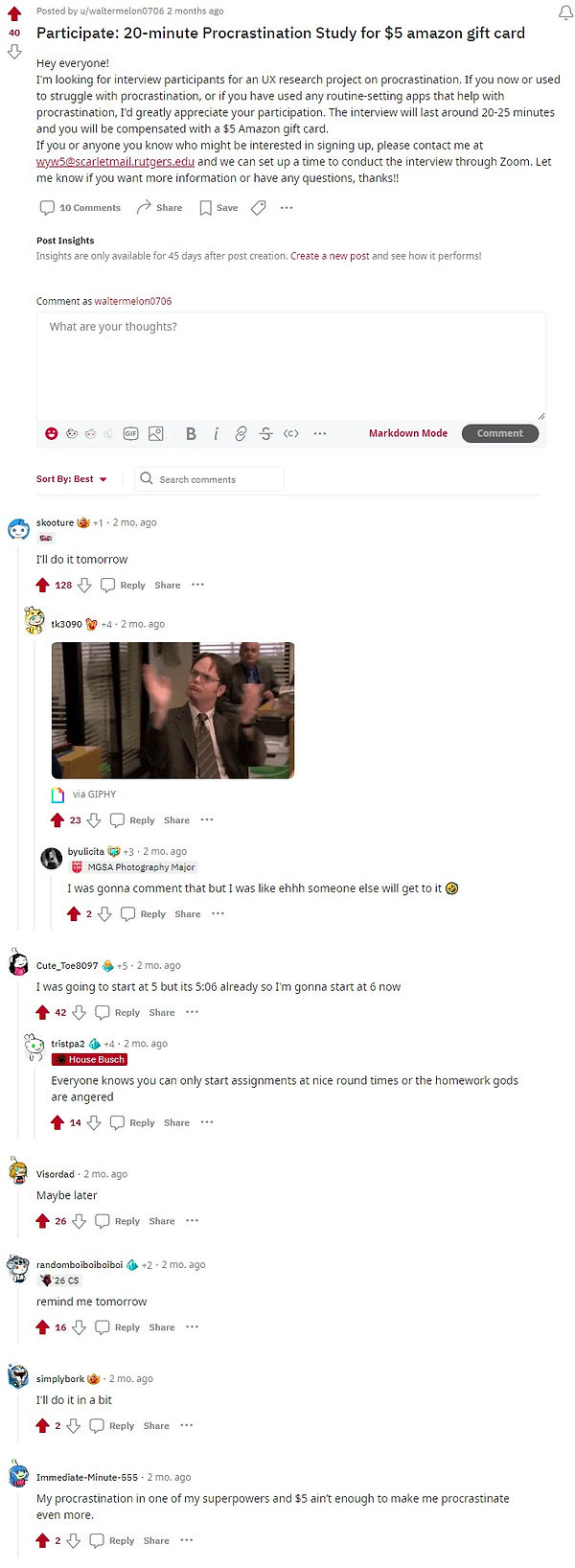
In order to gain a deeper and more personal understanding of procrastination in terms of people's thoughts, emotions, and behaviors, I went on to my school's reddit and tried to recruit 6 participants for user interviews.
After getting some banter for the post... fortunately there were a lot of people who actually reached out.
I conducted semi-structured interviews because I thought on a relatable topic like procrastination, being less formal and having fun connecting during the discussion will bring out the most personal and important insights. Here are the main questions that I explored:
-
Can you tell me about the last time you procrastinated doing something?
-
What was the task and what do you do when procrastinating?
-
How did you feel?
-
-
Why do you think you procrastinate them?
-
What are some of the different tasks you procrastinate on and w
-
-
Tell me about a time you procrastinated but overcame it.
-
How did you overcome
-
How did you feel
-
-
Currently, what are some things you practice that help you prevent procrastination?
-
What are your experiences with them?
-
Results
After conducting the interviews and analyzing the data, I came up with these major insights:
1. People procrastinate on different tasks:
2. People procrastinate differently:
- Personal ("no-deadline tasks")
-
participants don't really care about these tasks as they find them simply unimportant, uninteresting, unenjoyable, and useless
-
i.e. homework assignments for a class outside their major
-
they are unmotivated to do these tasks
-
these tasks are more important tasks such as influential choices in their lives (choosing a major or career path, learning a new programming language, even starting to workout and sleep
-
usually have no deadlines and require more effort and time to achieve
-
procrastination on these tasks causes more shame and guilt than "deadline tasks"
-
participants are usually motivated but don't know where to start
- Passive Procrastinator:
- Academic ("deadline tasks")

- Active Procrastinator:

3.
While considering their past experiences with routine-setting or calender apps, 5 out of 6 participants thought "social support" and "Swiss-Chesse It" would be helpful.
Iterations & Usability Testing
After the designer finished low-fi wireframes, I conducted 2 rounds of usability testing with 6 particpants and gave 4 major actionable insights for the designer:
1. Addition of information page that promotes the two methods

The main screen contains a swiss-cheese icon indicating the "Swiss-cheese It" method, but 4 out of 6 participants did not understand the icon. Since we want to help users overcome procrastination by using the "swiss-cheese it" and "social support" aspects, I suggested we include information about those before the main user flow begins.
2. Change in navigation bar


Participants felt overwhelmed by the 3 categories on top and 3 tabs on the bottom. So changing the navigation bar to a submenu on top made the flow more natural.


3. Changes in the community screen
3 out of 6 participants said they thought the little circle on the top right of the icon means "notification," so I suggested we change to a hovered "gray" state. It was also necessary to keep the "add friend" icon consistent across all "all, friends, my" community pages.
4. Add separate posting screen

All participants were confused on how to "post" on their feed. The old posting process was too minimal and I thought it'd be a good idea to create a separate posting screen, taking inspiration from Instagram.
Reflections & Challenges
1. Explore different solutions
As I look back and review the project, I realized that we did not fully explore other options such as VR or even a physical solution. In the real world, it is definitely not the case that we easily decide that a mobile interface would be the solution. In the future, I will be more mindful of finding the right solution for the problem.
2. Focus on doing the right work rather than producing a good outcome.
When I reflect back on the project, I can't help but feel that part of me was focusing on producing a good outcome instead of really solving the problem. While I did mostly do the right work such as focusing on the frameworks of secondary research, competitive analysis, and user interviews, I imagine real UX practitioners go through the process with flexibility, freedom, and focus more on the actual problem and the user. In the future, I plan on using more critical thinking rather than just employing different techniques.
3. How does "business" affect UX? How does it work with other departments such as Marketing?
In personal projects, "business" is never a concern because stakeholders aren't involved. However, in real-world UX, I'm really interested in how different factors like business can affect UX decision-making.
4. UX is an infinite ∞ loop
Again, when I look back and review the project, I realized I missed the first step of overcoming procrastination, which according to the McGraw Center is "Awareness". So that got me thinking: "how do we get users to be aware of their procrastination motivations and actually start using our product". While that question may never be answered, a simple solution may be working with Marketing of product and adding "Resources" to our product. This made me realize that improving user experience is a continuous process, not an "one-and-done" process.